

Bastion sandbox
The Bastion sandbox is a secure, isolated testing environment where you can experiment with our API without impacting live production data. It provides a full-featured replica of our production API, allowing you to:- Test API integrations: Validate your application’s interaction with Bastion’s APIs in a risk-free setting.
- Explore features: Discover and understand the capabilities of our platform, from managing accounts and identities to stablecoin transfers and webhooks.
- Build a POC: Quickly develop and validate proof-of-concept integrations using realistic test data, allowing for efficient building and debugging.
- Account management: Create, list, and retrieve accounts, and check account balances.
- Identity services: Manage individual and business identities, including compliance data submission (KYB/KYC) and payment instruction creation.
- Stablecoin transfers: Initiate and track stablecoin transfers.
- Transaction signing (coming soon): Test signing raw transactions and data.
- Webhooks: Configure and test webhooks for real-time event notifications.
Access sandbox
The sandbox is a test environment you can access by contacting sales. Once you have access, you receive a unique and confidential test API key and can sign in to the Bastion sandbox dashboard. To gain access, contact us at sales@bastion.com. Our team reviews your request and responds with access to the sandbox, along with additional instructions and terms of use.Sandbox dashboard
Once you have access to the sandbox environment, go to the Bastion sandbox dashboard.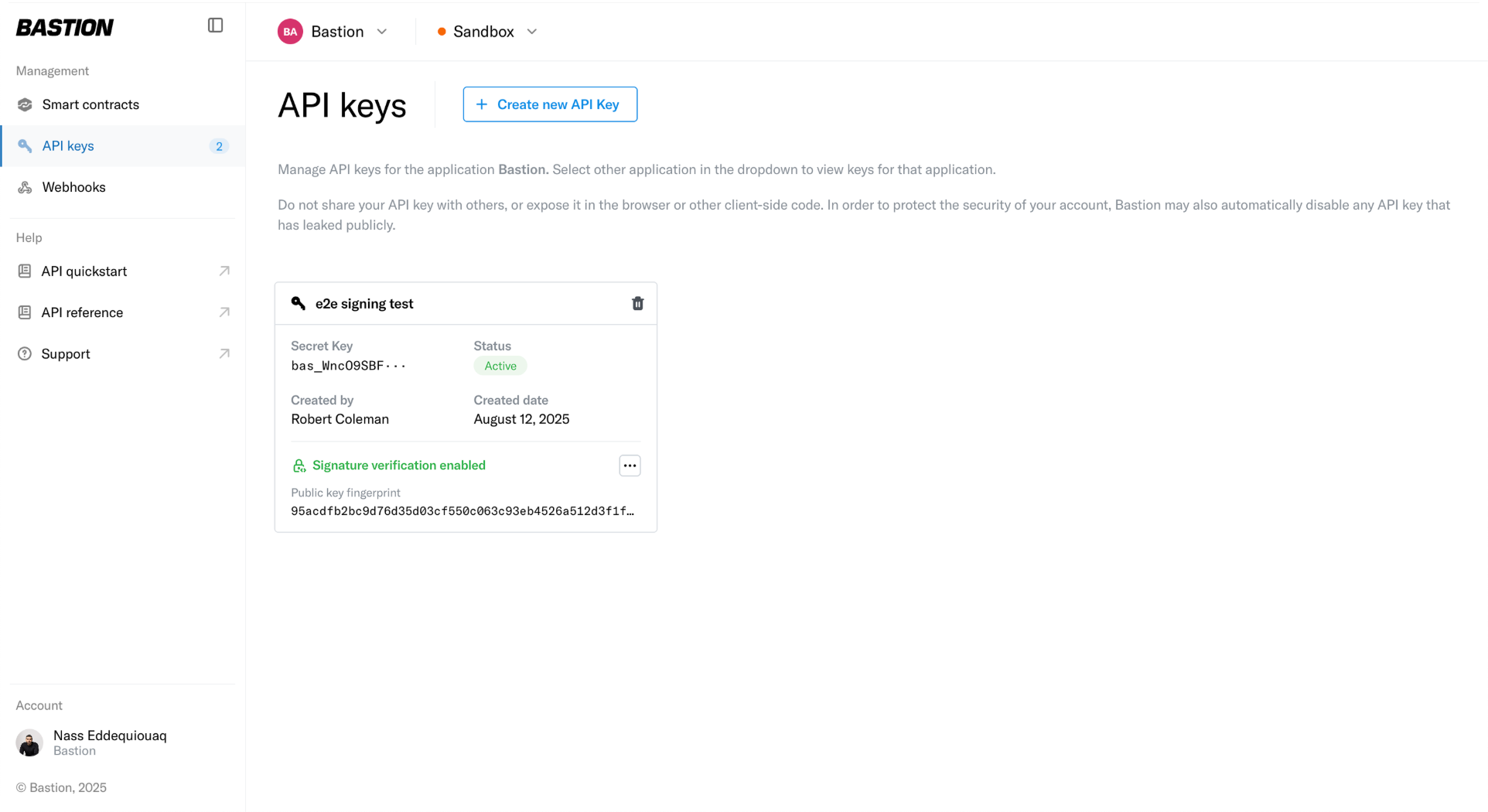
Sandbox APIs
Our sandbox API base URL ishttps://api.sandbox.bastion.io.
The API consumes and produces the following media type:
Create a sandbox API key
- Go to the
API keystab on the left, and selectCreate new API Key. - A small pop-up window appears, prompting for an API key name.
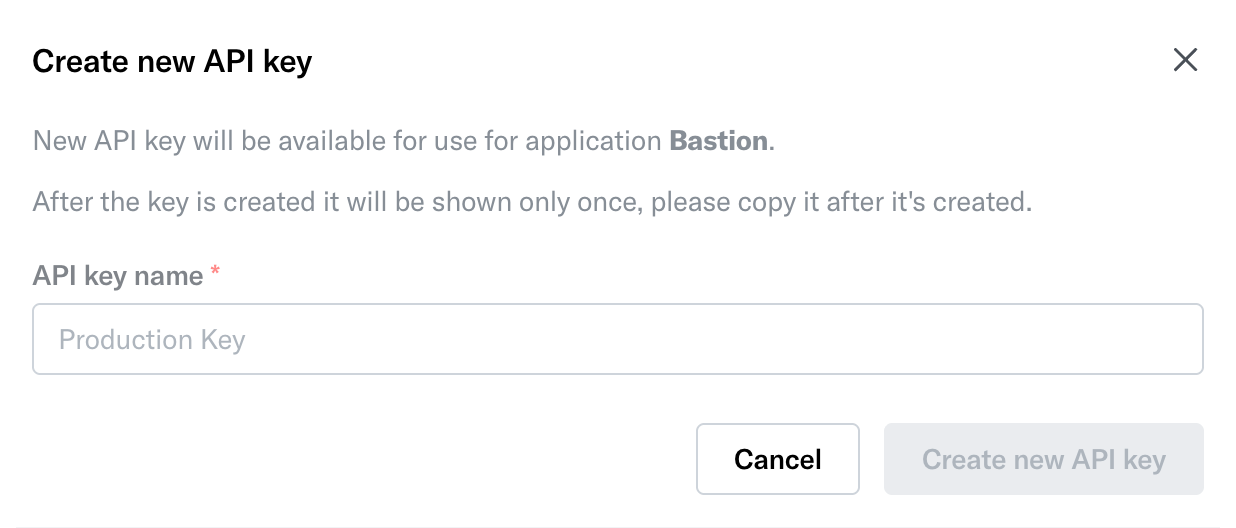
- Once you provide an API key name, select
Create new API key. A secret test API key is displayed for you to save. Make sure to store this test secret key. You cannot retrieve it afterward.
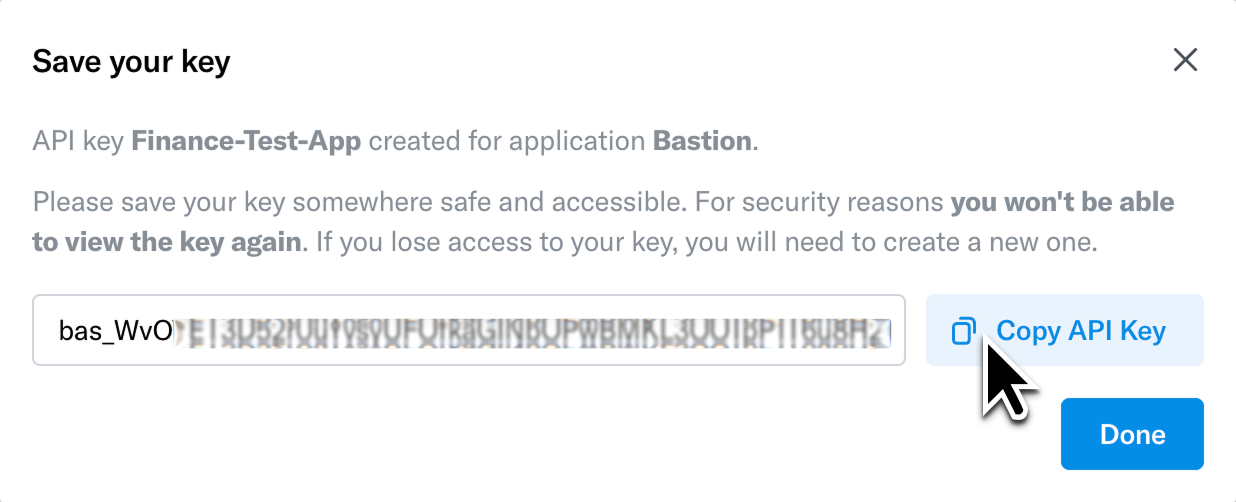
Your API key is unique to your organization. Do not share it with unauthorized individuals or expose it in client-side code, public repositories, or configuration files.
Pass the sandbox API key in request headers
Once you have your API key, include it in the request headers for every API call. Follow these instructions to pass the key in the Authorization header:- Set the Authorization header in your HTTP requests.
- Use the Bearer scheme followed by a space and the API key. The header should look like this:
- Replace
<your-api-key>with the actual API key provided to you and add it to the request. For example, if you are using cURL to make a request to our API, you can include the Authorization header as follows: